Blog

  • The Power of Precision: Goal Setting for UK Recruitment Agents

    The Power of Precision: Goal Setting for UK Recruitment Agents

    Introduction: Navigating the Recruitment Landscape

    In the fast-paced world of recruitment, UK agents face a myriad of challenges. From the pressure to meet placement targets to the need to adapt to the ever-evolving job market, the role of a recruitment agent is as demanding as it is rewarding. In such a competitive environment, the difference between success and stagnation often lies in the ability to set and achieve tangible goals.

    The Catalyst of Success: How Goal Setting Can Alleviate Recruitment Struggles

    Goal setting is not just about identifying what you want to achieve but also about giving yourself the means to track and reach those milestones systematically. For recruitment agents, this could translate into a variety of objectives, from increasing the number of successful placements to enhancing client satisfaction or expanding into new industry sectors.

    Statistics reveal that individuals with clearly defined, written goals are 42% more likely to achieve them than those without. In a profession where success is quantified by results, UK recruitment agents can harness the power of goal setting to focus their efforts, streamline their processes, and ultimately, outperform their competitors.

    The Blueprint for Achievement: SMART Goal Setting

    To set goals effectively, recruitment agents should employ the SMART criteria:

    • Specific: Clearly define what you want to achieve. Instead of “I want to get more clients,” aim for “I want to acquire five new clients in the technology sector each quarter.”
    • Measurable: Establish concrete criteria for measuring progress. “Increase candidate placements by 15% over the next six months” is a goal whose progress can be tracked.
    • Achievable: Ensure that your goals are attainable. Setting the bar too high can be as counterproductive as setting it too low.
    • Relevant: Your goals should align with the direction you want your career and agency to take. If expanding your market is a priority, a goal like “Develop expertise in the renewable energy job market by the end of the year” would be fitting.
    • Time-bound: Every goal needs a deadline. It creates urgency and prompts action. “Secure two new client contracts by the end of Q2” is a time-bound goal that can keep you focused.

    Top Tips: For example, instead of setting a vague goal like “increase placements,” a SMART goal would be “increase placements by 10% within the next quarter.” This goal is not only specific and time-bound, but it also allows for tracking progress and adjusting strategies as needed.

    Furthermore, it’s crucial for agents to review their goals regularly. Setting aside just five minutes every Monday to track progress can make a significant difference. This habit ensures that goals remain at the forefront of an agent’s weekly agenda and allows for timely adjustments.

    Leveraging Tools for Success: Our Goal-Setting Template

    To assist you in this critical task, we’ve created a goal-setting template tailored for recruitment agents (Get yours below). This tool is designed to help you articulate your goals clearly and track your progress with ease. By spending just five minutes every Monday reviewing your goals, you can adjust your strategies, celebrate small victories, and stay on course for the bigger ones.

    Conclusion: The Strategic Edge

    In conclusion, good goal setting is not just a task to be checked off but a strategic advantage that can elevate your performance as a recruitment agent. It’s the compass that guides your daily actions and the catalyst that propels you towards success. Use our template, set your goals, and take those five minutes every Monday to ensure you’re not just moving, but moving in the right direction.


    By integrating these insights and strategies into your professional routine, you can transform the way you approach your role as a recruitment agent in the UK. With goal setting as your ally, you’re not just surviving the recruitment landscape; you’re mastering it.

    Get ready to go on the week ahead by watching this video:
  • 12 Weeks of Wisdom series:

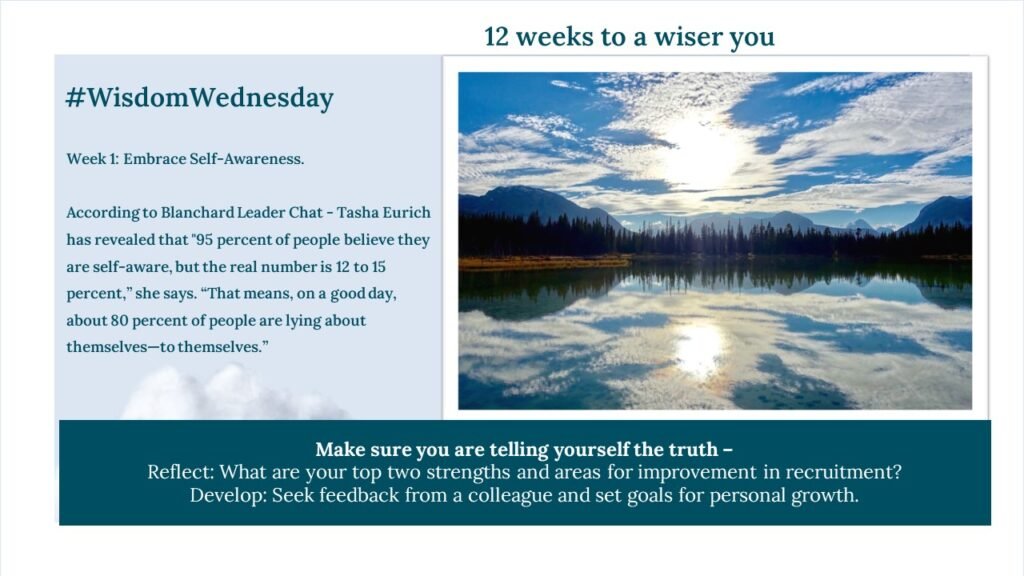
    Week 1: Embrace Self-Awareness.

    Reflect: What are your top two strengths and areas for improvement in recruitment?

    Develop: Seek feedback from a colleague and set goals for personal growth.

    Week 1: Embrace Self-Awareness. 

According to Blanchard Leader Chat - Tasha Eurich has revealed that "95 percent of people believe they are self-aware, but the real number is 12 to 15 percent,” she says. “That means, on a good day, about 80 percent of people are lying about themselves—to themselves.”

    Week 2: Cultivate Curiosity.

    Reflect: When did you last discover something surprising about a candidate?

    Develop: Ask open-ended questions in your next interviews to uncover deeper insights.

    Week 2: Cultivate Curiosity. 

According to Ness Labs curiosity questions happen 2.36 times in a two hour stretch in young childhood, and only 0.48 times when talking to 10 year olds in school.

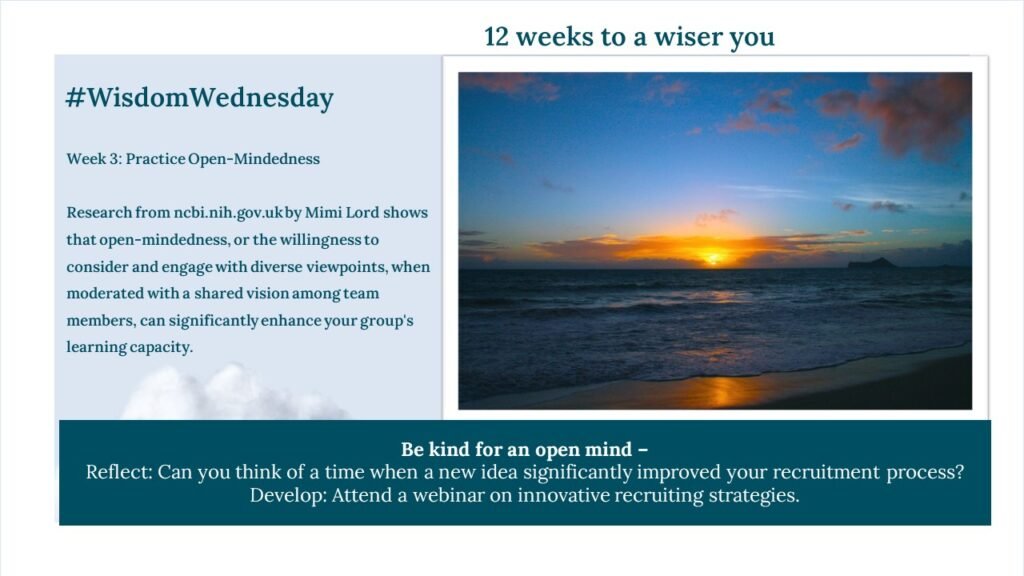
    Week 3: Practice Open-Mindedness.

    Reflect: Can you think of a time when a new idea significantly improved your recruitment process?

    Develop: Attend a webinar on innovative recruiting strategies.

    Week 4: Develop Empathy.

    Reflect: Recall a moment you truly felt the challenges of a candidate.

    Develop: Practice active listening in your next candidate conversation to foster deeper empathy – What are 3 things that they told you?

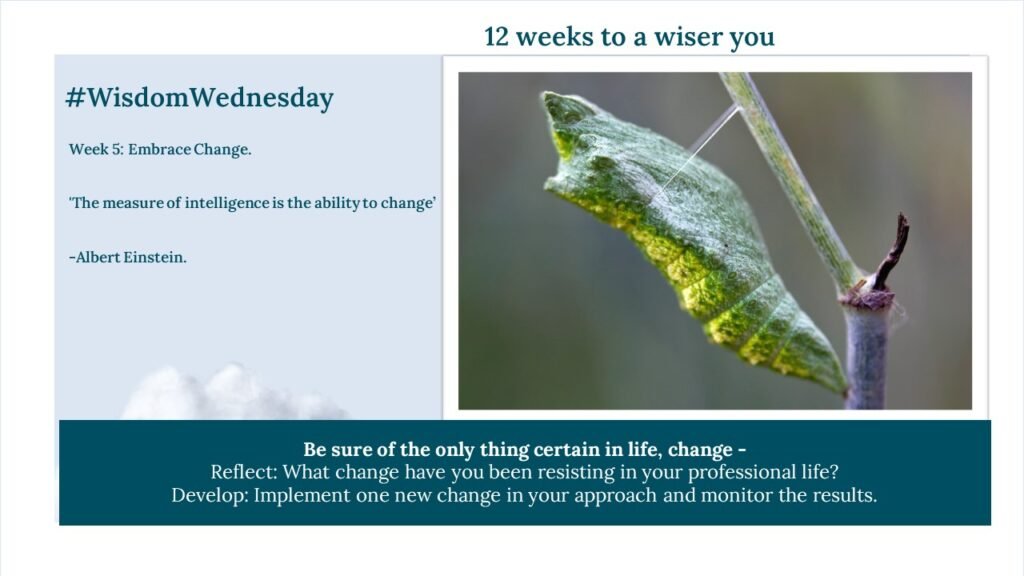
    Week 5: Embrace Change.

    Reflect: What change have you been resisting in your professional life?

    Develop: Implement one new change in your approach and monitor the results.

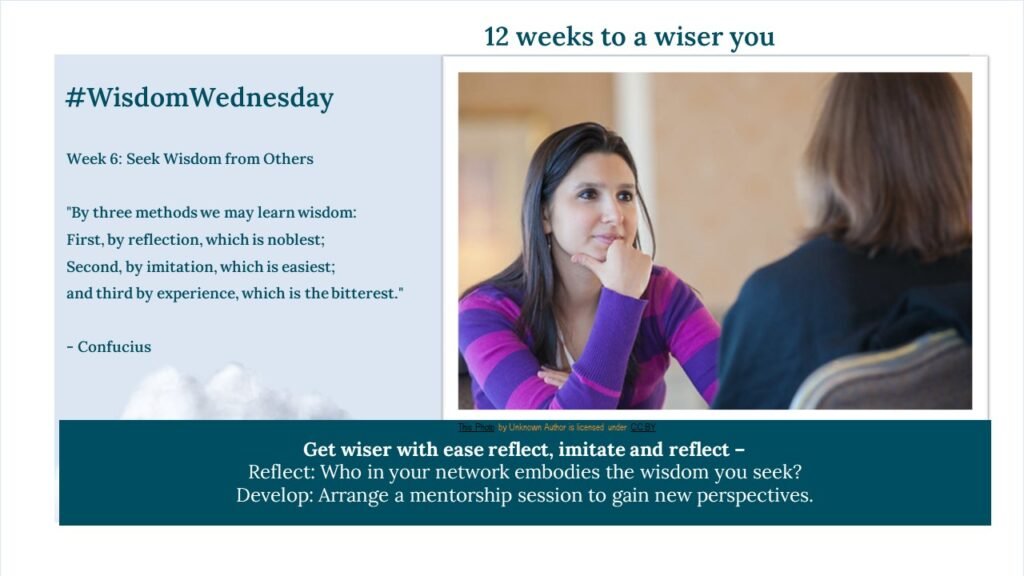
    Week 6: Seek Wisdom from Others.

    Reflect: Who in your network embodies the wisdom you seek?

    Develop: Arrange a mentorship session to gain new perspectives.

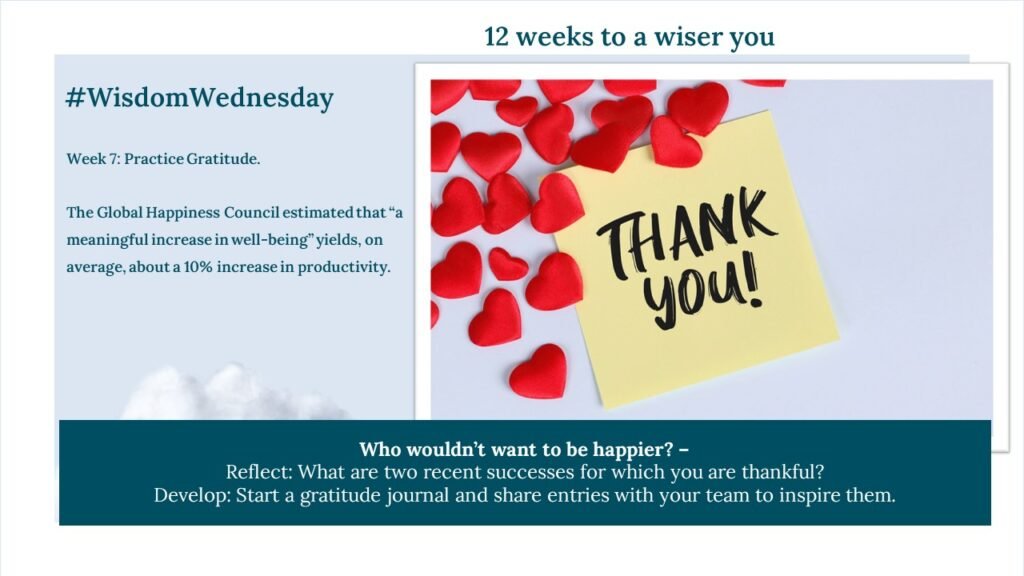
    Week 7: Practice Gratitude.

    Reflect: What are two recent successes for which you are thankful?

    Develop: Start a gratitude journal and share entries with your team to inspire them.

    Week 8: Prioritize Humility.

    Reflect: How have others contributed to your success?

    Develop: Publicly acknowledge these contributions in your next team meeting.

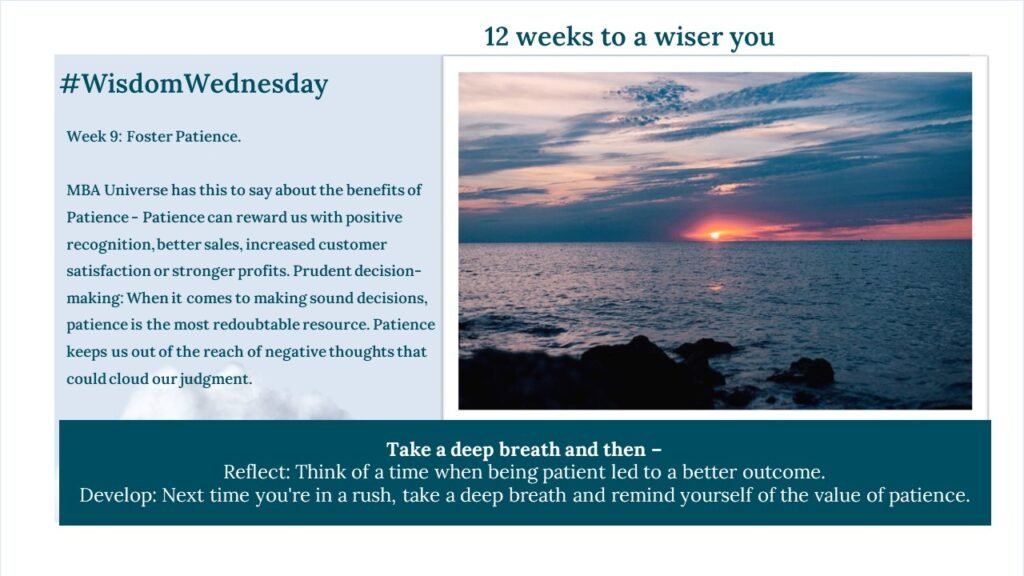
    Week 9: Foster Patience.

    Reflect: Think of a time when being patient led to a better outcome.

    Develop: Next time you’re in a rush, take a deep breath and remind yourself of the value of patience.

    Week 10: Value Simplicity.

    Reflect: Identify two processes that could be simplified.

    Develop: Choose one and take steps to streamline it for you and your team.

    Week 11: Find Joy in the Journey.

    Reflect: What aspects of your job bring you the most joy?

    Develop: Incorporate more of these joyful aspects into your daily routine.

    Week 12: Live Authentically.

    Reflect: Are your personal values aligned with your professional actions?

    Develop: Create a mission statement for your recruitment practice that reflects your true self.

  • The Art of Transparent Communication: Explaining Your Meeting Intent

    Have you ever received a call or message from someone who spoke for a while before revealing the purpose of their contact? It’s frustrating, right? This scenario highlights the importance of transparent communication, especially when explaining the reason behind requesting a meeting with a prospect. In the world of business, clarity and directness go a long way in establishing trust and building meaningful connections.

    Getting to the Point:

    Psychologists have found that people are 34% more likely to comply with a request if the reason behind it is provided upfront. This principle holds true in various situations, including arranging meetings with potential clients. When you quickly and clearly state the purpose of your meeting, you’re showing respect for your prospect’s time and attention.

    The Power of Explaining Your Meeting Intent:

    Consider two scenarios. In the first scenario, you receive a message asking if you have half an hour to spare on Tuesday afternoon for a meeting. In the second scenario, you’re asked if you can spare half an hour on Tuesday afternoon to discuss two specific candidates and how they would be an excellent fit for your needs. Which scenario would you find more appealing and be more likely to agree to?

    In the second scenario, the individual explains the purpose of the meeting right away. This approach not only saves your time but also provides a clear understanding of what to expect and allows you to mentally prepare for the meeting. When you’re on the receiving end, the second option sounds more appealing because it’s upfront, transparent, and lets you know exactly what you’ll be discussing.

    Building Trust Through Clear Communication:

    When you’re prospecting or reaching out to potential clients, showing them that you value their time and are forthcoming with information can go a long way in building trust. Rather than leaving them guessing about the purpose of the meeting, you’re providing them with essential details upfront. This establishes a foundation of trust and demonstrates your professionalism.

    Transforming Outcomes: Practical Examples:

    1. Client Engagement: Instead of a vague meeting request, try: “Could we schedule a meeting to explore how our strategic recruitment approach can streamline your hiring process and assist with [example of current business challenges they are facing]?” In order to do this well, spend some time researching the challenges facing the client, all business challenges can be solved with the right problem-solving approach after all.
    2. Candidate Interaction: Instead of a generic message, opt for being direct and clear with the candidate. If you have a specific role you are considering them for try something like: “I’d love to discuss [specific job, rate, duration, etc.] that could propel your career forward as it aligns to [their specific skillset and job requirements. Can we chat about it?” . If you would like to engage the candidate before you have something specific in mind, spend a few minutes understanding what it is you want to get out of the interaction and what questions could help you get there. If it is that you would like to use the candidate to talk to a client about solving a problem of theirs, talk to the candidate and help them to understand exactly what you are trying to do and how it could turn out (both good and bad). Being specific helps show your integrity which will make candidates want to work with you years from now.
    3. Clear Agenda: Always begin the meeting with a brief overview of what you intend to cover. For instance, “In this meeting, I’ll present how our comprehensive candidate sourcing strategy aligns with your company’s growth goals. I will go on to what we need from you in order to best support your companies strategy, and lay out a plan on how to take practical action that will benefit us both.”

    Conclusion:

    Transparent communication is a powerful tool in the world of business. When you clearly explain why you want a meeting and what solutions you have to offer, you’re respecting your prospect’s time, establishing trust, and setting the tone for a productive discussion. By adopting this approach, you’re showcasing your professionalism and genuine interest in meeting your client’s needs. So, the next time you reach out for a meeting, remember that clarity and transparency pave the way for meaningful connections and successful collaborations.

    Further reading:

    If you want further tips on really persuading your audience to meet with you Forbes has written a great article here.

    Summarizing the key points from the article into a handy mnemonic:

    LCTTP – Listen, Care, Trust, Terms, Process

    1. Give people a reason to listen to you.

    Start with a clear and concise message (30 seconds or less) that helps them understand what they will get from investing more than 30 seconds in listening to you.

    2. Show people that you truly care about them and their needs.

    Give one very good example of how solving their problems helps solve one of your own problems, or otherwise has a deeper meaning for you.

    3. Give people a reason to trust you.

    Showcase your personal track record, give examples of where others have long term relationships with you or where you have garnered repeat business. Likeability/Social Proof.

    4. Present your ideas in terms of pros and cons that will connect with your audience.

    Broaden out describing how the longer term relationship will benefit them (WIIFM) and their organisations strategy (WIIFO) in the future, and how you can grow with them given your specific skills and how that matches their personal approach.

    5. Define the action steps and clarify the process.

    Give them a clear 4-5 step plan on next steps to get from where you are with them at the end of the call, to the very next step in your plan. Make the last step a clarification of the bigger picture process of the longer term goal.

  • Think your clients blanketing Inside IR35 is OK? Think again!

    Looks like this option for saving clients from HMRC fines is about to be busted, 1500 contractors are filing a class lawsuit against clients where they have been unfairly ruled inside IR35. More are set to join. If you want to support your clients, the only way is to be abreast of the law and help them to do the right thing.

    Read the legal futures article here: https://www.legalfutures.co.uk/latest-news/contractor-claims-specialist-abs-aims-to-open-floodgates

  • GDPR non-compliance is hitting hard

    META has now been fined €1.2bn in the biggest ever GDPR fine, how can you make sure your agency isn’t next? 2023’s list of big fines is as follows:

    https://dataprivacymanager.net/5-biggest-gdpr-fines-so-far-2020/

  • IR35 resulting in massive fines – £300M & counting

    HMRC has fined clients over £300M to date, several of whom would have worked with recruitment professionals just like you, and could have avoided these fines if they had the right support. What difference could you make to your clients if your team was up-to-date with the law? How much more would your clients trust your services over others if you could stand out in this way?

    Even government departments have been fined – isn’t it time we straightened all this out?

    https://www.morganjones.co.uk/2023/06/hmrc-fines-uk-government/